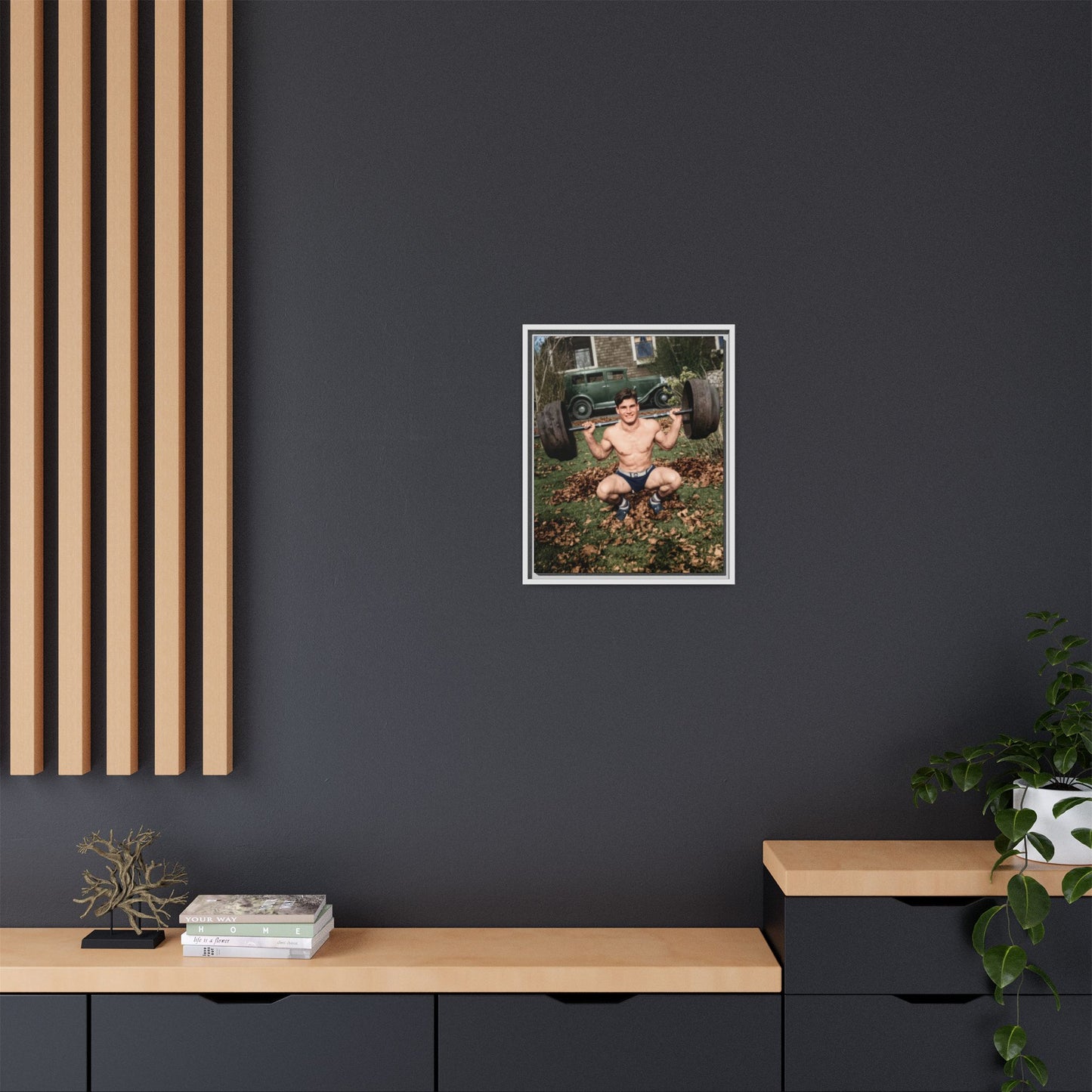
This vintage photograph is part of the Ephemera of Us: Vintage Photo Collection, within the section titled “célibataire” — the French word for “single.” The designation speaks not to absence, but to singularity: a single figure, a single instant, a moment held in suspension. In contrast to images defined by pairs or groups, these photographs center the individual — standing alone, seated alone, walking alone — framed not by companionship but by presence. The composition often emphasizes posture, gesture, or gaze directed inward or outward without immediate exchange, inviting reflection on what it means to occupy one’s own space.
Original Photograph Record
Title: Male Figure Squatting with Barbell in Residential Yard
Date (estimated): 1928–1935
The estimated date is based primarily on the automobile visible in the background, which exhibits body styling, wheel design, and fender contours consistent with late 1920s to early 1930s American passenger vehicles. The subject’s hairstyle and athletic attire, including brief athletic trunks and striped knee socks, are also consistent with recreational sportswear of the interwar period. The small-format vernacular appearance supports this timeframe.
Photographer: Unknown
Place of Production: Unknown
Medium: Gelatin silver print (probable)
Dimensions: Small-format amateur print, 2½ × 3½ in.
Original Photo – Condition & Preservation Status
The print shows moderate tonal fading, particularly in highlight areas of the subject’s torso and facial features, resulting in reduced contrast. Minor surface abrasions and small speckling are visible throughout the image area, consistent with handling wear. There is slight tonal compression in both highlight and shadow regions, limiting fine detail in the background structure and ground surface. No major tears or structural losses are visible within the image field. Edge wear cannot be fully assessed from the reproduced view. These factors moderately affect legibility of fine details but do not obscure the primary subject matter. Archival housing and careful digitization would help preserve remaining tonal information and stabilize surface wear.
Material, Process & Historical Placement
The image’s neutral grayscale tonal range, matte surface appearance, and moderate contrast are characteristic of gelatin silver prints on developing-out paper, the dominant black-and-white process from the early 20th century onward. The informal outdoor setting, candid composition, and visible personal automobile align with the increasing accessibility of portable cameras during the interwar years, when amateur photography became widespread. The absence of studio mounting or printed borders suggests private production rather than commercial studio work. Research limitations include the absence of inscriptions, maker’s marks, or documented provenance.
Collector’s Summary
Circa 1928–1935 gelatin silver amateur print depicting a male figure performing a barbell squat in a residential yard setting with a period automobile visible in the background.
While it is impossible — and historically inappropriate — to determine the sexuality or personal identities of the individuals depicted, the figure presented alone carries a particular visual resonance. Solitary images preserve moments of pause: between movements, between relationships, between destinations. The late nineteenth and early twentieth centuries were structured by rigid social expectations, yet photography occasionally captured individuals in quiet autonomy. To be alone in a photograph was not necessarily to be isolated; it could also signify independence, contemplation, or self-possession. These images challenge modern assumptions that solitude implies absence. Instead, they document the dignity of singular presence.
The image presented here has undergone careful digital preservation using contemporary restoration technologies, including AI-assisted stabilization, tonal repair, and historically guided colorization. All interventions were directed by archival conservation principles and fine-art print standards, ensuring retention of period character, natural tonal modeling, and photographic softness. The aim is not reinterpretation, but clarity — safeguarding a fragile visual record of individuality and the enduring human experience of standing, however briefly, on one’s own.