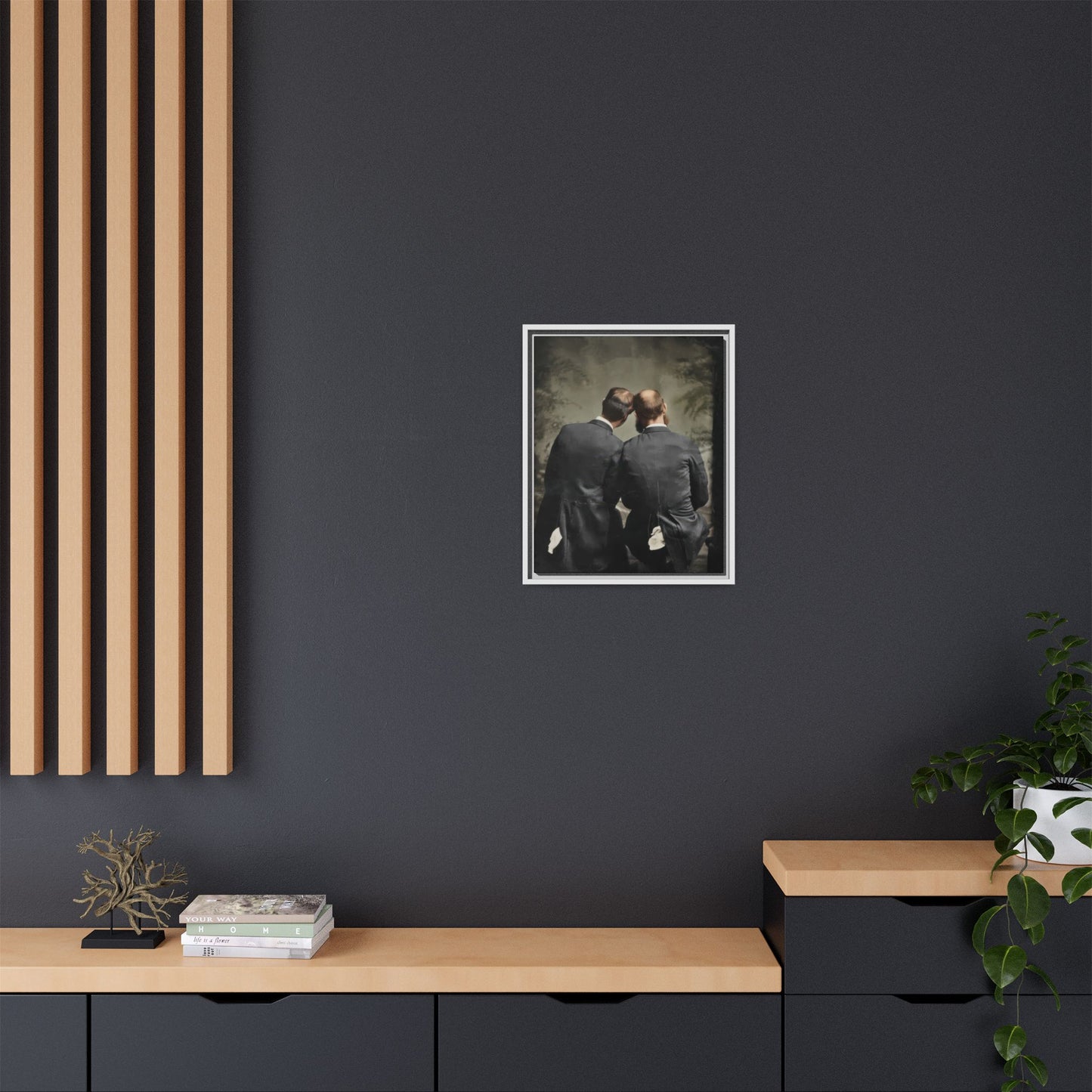
This vintage photograph is part of the Ephemera of Us: Vintage Photo Collection, within the section titled “paire” — the French word for “pair.” The designation reflects the presence of two men pictured together in a moment of visible closeness. While it is impossible — and historically inappropriate — to determine the sexuality or personal identities of the individuals depicted, the composition conveys a quiet intimacy through gesture, proximity, and shared gaze. Such images have often been described by scholars as representations of “affectionate men,” a visual category that acknowledges documented forms of male tenderness and companionship in earlier eras. Whether understood as friendship, kinship, or something more personal, the photograph preserves a moment of male relational closeness that challenges modern assumptions about emotional expression between men.
The image presented here has undergone careful digital preservation using contemporary restoration technologies, including AI-assisted stabilization, tonal repair, and historical colorization. All interventions were guided by archival photo conservation principles and fine-art print standards, with the aim of maintaining period character, photographic softness, and material authenticity while improving legibility for modern viewers. It stands as a testament to both the layered ways intimacy was lived and recorded in the past and to the evolving methods used to safeguard fragile visual history in the present.
Original Photograph Record
Title: Two Men Seated with Backs to Camera in Studio Setting
Date (estimated): circa 1905–1915
Photographer: Unknown
Place of Production: Unknown
Medium: Gelatin silver print
Dimensions: Small-format print, approximately 3 x 5 inches
Original Photo – Condition & Preservation Status
The photograph exhibits characteristics consistent with an early twentieth-century gelatin silver print. The tonal range is moderate, with softened highlights and some compression in darker areas, particularly in the black jackets. The surface shows visible abrasions and handling marks, including vertical scratches and minor scuffing across the image plane.
Edge wear is present along all borders, with slight chipping and darkened perimeter areas suggesting prolonged handling or album storage. The corners appear softened rather than sharply defined. There is mild silvering or reflective change visible in darker regions near the edges, indicating age-related alteration of the silver image layer.
These conditions moderately affect contrast but do not significantly compromise legibility. The figures’ clothing, hair parting, and posture remain clearly readable. Archival housing in acid-free materials and minimal exposure to light would help prevent further deterioration of the silver image.
Material, Process & Historical Placement
The neutral monochrome tonality, paper-based support, and absence of the brown cast typical of albumen prints support identification as a gelatin silver print. This process became dominant in commercial and amateur photography from the 1890s onward.
The subjects wear tailored dark suits with structured shoulders and narrow lapels, paired with white shirts and neatly parted hair. The hairstyle—smooth, side-parted, and close-cropped at the sides—is consistent with early twentieth-century fashion. The cut of the jackets and the overall silhouette support a date range of approximately 1905 to 1915.
The painted backdrop and posed arrangement indicate a studio environment. No studio imprint, insignia, or location information is visible. Due to the absence of inscriptions or mounts, the photographer and place of production remain Unknown.
Collector’s Summary
Circa 1905–1915 gelatin silver studio print depicting two men seated with their backs to the camera; moderate surface wear and edge aging consistent with early twentieth-century vernacular portrait photography.