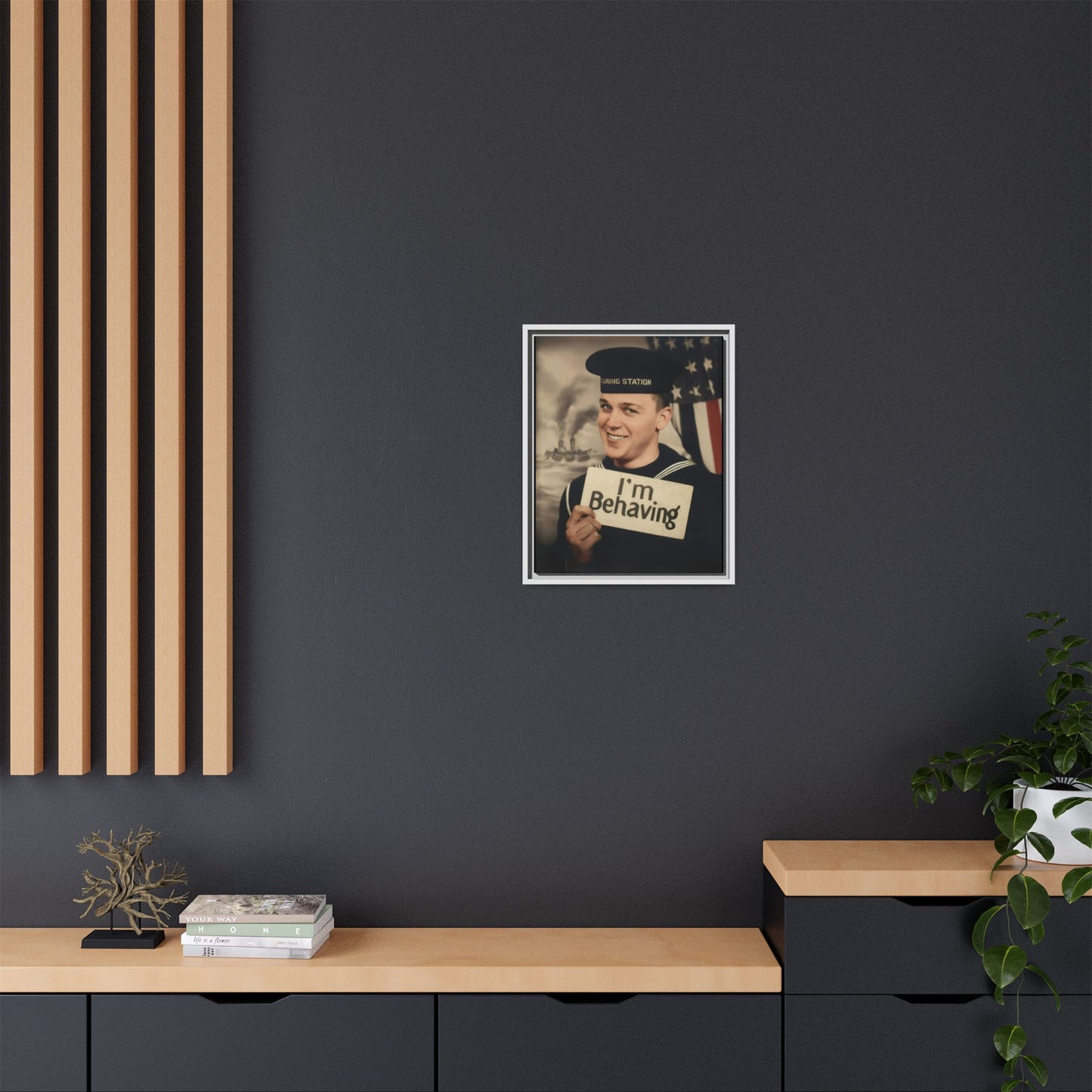
This vintage photograph is part of the Ephemera of Us: Vintage Photo Collection, within the section titled “célibataire” — the French word for “single.” The designation speaks not to absence, but to singularity: a single figure, a single instant, a moment held in suspension. In contrast to images defined by pairs or groups, these photographs center the individual — standing alone, seated alone, walking alone — framed not by companionship but by presence. The composition often emphasizes posture, gesture, or gaze directed inward or outward without immediate exchange, inviting reflection on what it means to occupy one’s own space.
Original Photograph Record
Title: Sailor Holding “I’m Behaving” Placard Before Painted Maritime Backdrop
Date (estimated): circa 1915–1925
The sitter wears a United States Navy enlisted uniform with a flat cap bearing the words “Training Station.” The generic wording, rather than a specific ship designation, suggests a studio prop or early training identification typical of the early 20th century. The painted backdrop depicts a steam-powered vessel with smokestacks and a stylized American flag, imagery commonly used in commercial portrait studios during the 1910s and 1920s. The typography and format of the novelty placard reading “I’m Behaving” are consistent with early novelty studio photography of this period. Based on uniform style, backdrop iconography, and studio prop conventions, the narrowest defensible date range is 1915–1925.
Photographer: Unknown
Place of Production: Unknown
Medium: Gelatin silver print (probable)
Dimensions: Small-format studio print, 3 x 5 inches
Original Photo – Condition & Preservation Status
The print exhibits moderate tonal contrast with some compression in the darker uniform areas. Minor edge wear is visible along the margins, with slight abrasions and small surface marks present in the background. The paper appears mildly warm, consistent with aging gelatin-silver materials. Highlights remain largely intact, though some subtle loss of shadow separation is visible in darker tonal regions.
These conditions slightly reduce clarity in dense shadow areas and background detail. Conservation stabilization and careful digitization would help preserve tonal information and prevent further surface degradation. No major structural tears or emulsion losses are evident within the visible image area.
Material, Process & Historical Placement
The matte surface, grayscale tonal range, and early-20th-century studio presentation strongly indicate a gelatin-silver process. By the 1910s, gelatin silver printing had become the dominant commercial photographic medium. The standardized small-format print without decorative mount reflects mass-produced studio portraiture intended for personal keepsake circulation.
The image aligns with broader early 20th-century studio portrait practices, particularly patriotic and maritime-themed backdrops popular during and shortly after World War I.
Research limitations include the absence of a photographer imprint, a studio stamp, an inscription, or a documented provenance.
Collector’s Summary
Circa 1915–1925 gelatin silver studio portrait of a United States Navy enlisted man holding a novelty placard before a painted maritime backdrop. Representative of early 20th-century commercial patriotic portrait photography in small-format print form.
While it is impossible — and historically inappropriate — to determine the sexuality or personal identities of the individuals depicted, the figure presented alone carries a particular visual resonance. Solitary images preserve moments of pause: between movements, between relationships, between destinations. The late nineteenth and early twentieth centuries were structured by rigid social expectations, yet photography occasionally captured individuals in quiet autonomy. To be alone in a photograph was not necessarily to be isolated; it could also signify independence, contemplation, or self-possession. These images challenge modern assumptions that solitude implies absence. Instead, they document the dignity of singular presence.
The image presented here has undergone careful digital preservation using contemporary restoration technologies, including AI-assisted stabilization, tonal repair, and historically guided colorization. All interventions were directed by archival conservation principles and fine-art print standards, ensuring retention of period character, natural tonal modeling, and photographic softness. The aim is not reinterpretation, but clarity — safeguarding a fragile visual record of individuality and the enduring human experience of standing, however briefly, on one’s own.