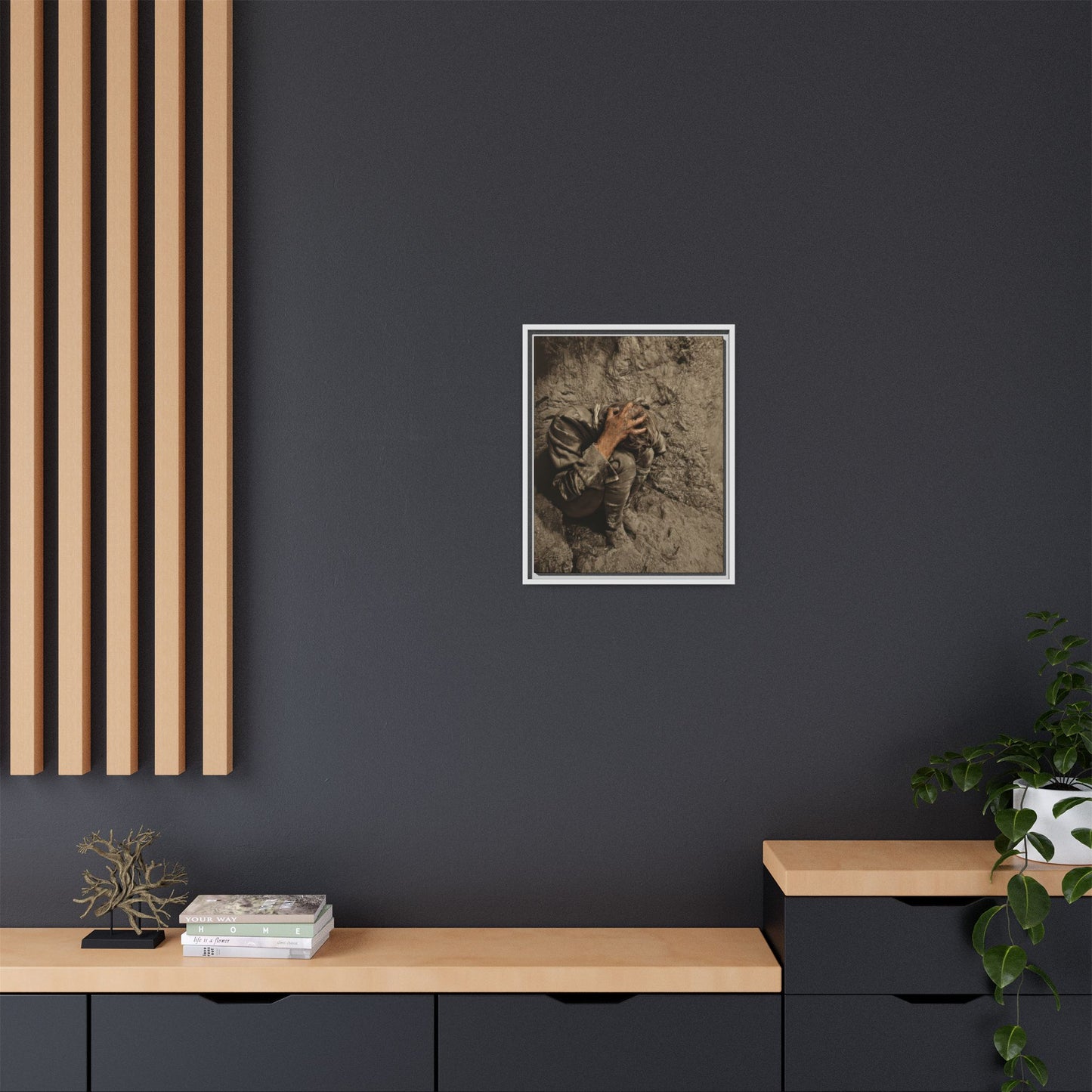
This vintage photograph is part of the Ephemera of Us: Vintage Photo Collection, within the section titled “célibataire” — the French word for “single.” The designation speaks not to absence, but to singularity: a single figure, a single instant, a moment held in suspension. In contrast to images defined by pairs or groups, these photographs center the individual — standing alone, seated alone, walking alone — framed not by companionship but by presence. The composition often emphasizes posture, gesture, or gaze directed inward or outward without immediate exchange, inviting reflection on what it means to occupy one’s own space.
Original Photograph Record
Title: Figure Crouched Against Earthen Embankment
Date (estimated): circa 1935–1945
The clothing visible—loose work shirt and utilitarian-cut trousers—suggests mid-20th-century manufacture. The absence of high Victorian tailoring details and the practical, unadorned garments align with styles common between the mid-1930s and mid-1940s. The image appears to be a small-format monochrome print without a decorative mount, consistent with gelatin silver prints widely produced during this period. Exact dating cannot be confirmed due to a lack of studio markings or contextual identifiers.
Photographer: Unknown
Place of Production: Unknown
Medium: Gelatin silver print (probable)
Dimensions: Small-format print, 3 x 4 inches
Original Photo – Condition & Preservation Status
The print exhibits strong contrast with areas of compressed shadow detail, particularly along the upper left margin. Highlights retain moderate separation but appear slightly diminished in the midtone transitions. Surface texture suggests minor abrasions and localized tonal irregularities consistent with handling wear. Slight edge darkening and possible silvering in dense shadow areas may be present, though reflectivity cannot be confirmed from the reproduction.
Such condition characteristics may reduce legibility in darker regions and obscure fine detail within fabric folds and surrounding earth textures. Conservation stabilization and high-resolution digitization would help preserve tonal information and prevent further surface degradation.
Material, Process & Historical Placement
The tonal scale, matte surface appearance, and grayscale rendering strongly indicate a gelatin silver process, the dominant photographic medium for vernacular and documentary images from the 1920s through the 1950s. The absence of a cabinet mount or postcard backing suggests mass-produced personal photography rather than late-19th-century studio practice.
The subject matter—an individual positioned outdoors against a natural earthen formation—aligns with documentary or informal snapshot traditions characteristic of mid-20th-century amateur or journalistic photography.
Research limitations include the absence of inscriptions, studio imprints, geographic markers, or accompanying provenance documentation.
Collector’s Summary
Circa 1935–1945 gelatin silver print depicting a figure crouched against an earthen embankment. Representative of mid-20th-century vernacular documentary photography in small-format print form.
While it is impossible — and historically inappropriate — to determine the sexuality or personal identities of the individuals depicted, the figure presented alone carries a particular visual resonance. Solitary images preserve moments of pause: between movements, between relationships, between destinations. The late nineteenth and early twentieth centuries were structured by rigid social expectations, yet photography occasionally captured individuals in quiet autonomy. To be alone in a photograph was not necessarily to be isolated; it could also signify independence, contemplation, or self-possession. These images challenge modern assumptions that solitude implies absence. Instead, they document the dignity of singular presence.
The image presented here has undergone careful digital preservation using contemporary restoration technologies, including AI-assisted stabilization, tonal repair, and historically guided colorization. All interventions were directed by archival conservation principles and fine-art print standards, ensuring retention of period character, natural tonal modeling, and photographic softness. The aim is not reinterpretation, but clarity — safeguarding a fragile visual record of individuality and the enduring human experience of standing, however briefly, on one’s own.