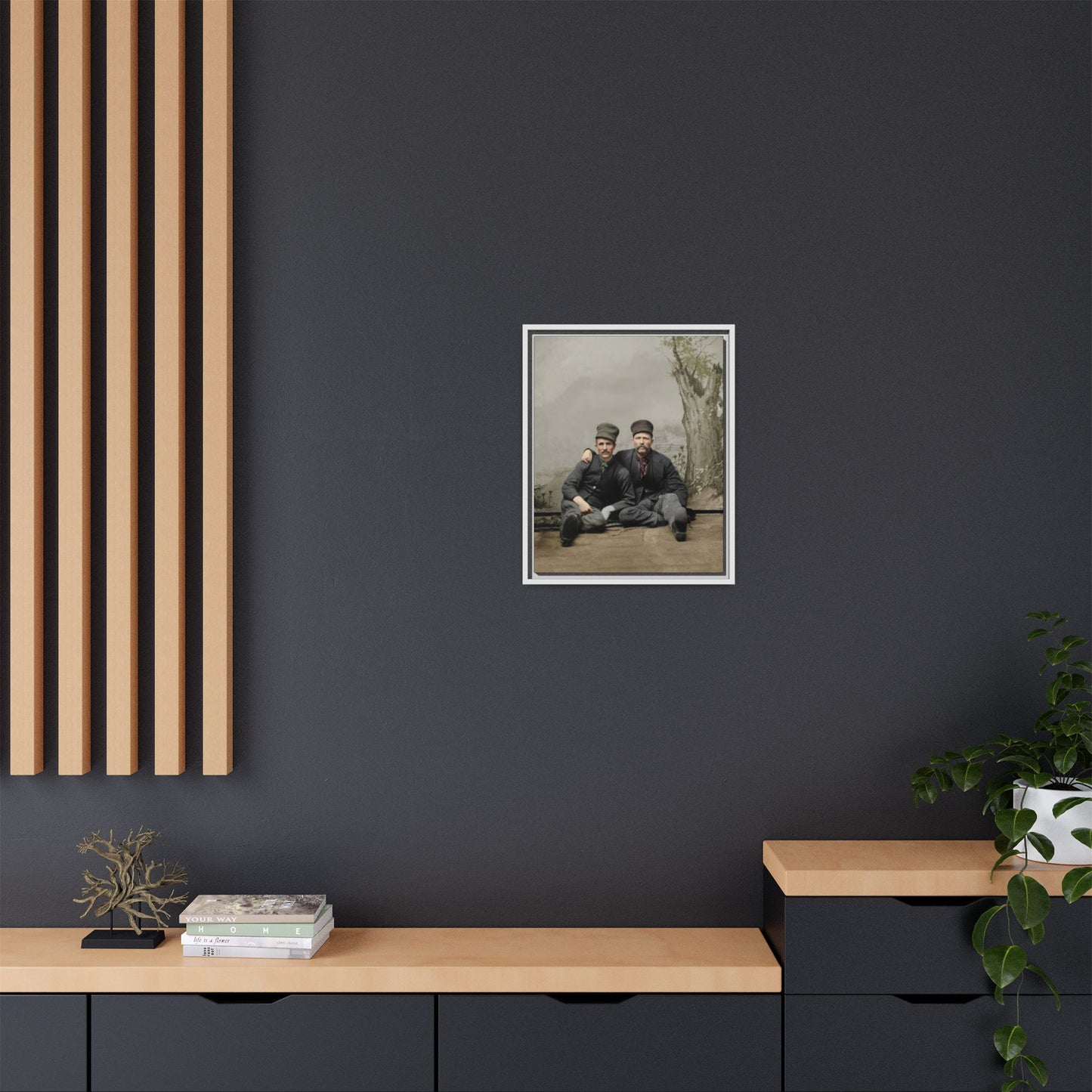
This vintage photograph is part of the Ephemera of Us: Vintage Photo Collection, within the section titled “paire” — the French word for “pair.” The designation reflects the presence of two men pictured together in a moment of visible closeness. While it is impossible — and historically inappropriate — to determine the sexuality or personal identities of the individuals depicted, the composition conveys a quiet intimacy through gesture, proximity, and shared gaze. Such images have often been described by scholars as representations of “affectionate men,” a visual category that acknowledges documented forms of male tenderness and companionship in earlier eras. Whether understood as friendship, kinship, or something more personal, the photograph preserves a moment of male relational closeness that challenges modern assumptions about emotional expression between men.
The image presented here has undergone careful digital preservation using contemporary restoration technologies, including AI-assisted stabilization, tonal repair, and historical colorization. All interventions were guided by archival photo conservation principles and fine-art print standards, with the aim of maintaining period character, photographic softness, and material authenticity while improving legibility for modern viewers. It stands as a testament to both the layered ways intimacy was lived and recorded in the past and to the evolving methods used to safeguard fragile visual history in the present.
Original Photograph Record
Title: Two Men Seated on Studio Floor before Painted Landscape
Date (estimated): c. 1885–1895
Photographer: Unknown
Place of Production: Unknown
Medium: Tintype (ferrotype)
Dimensions: Small-format plate; 3 x 5 in.
Original Photo – Condition & Preservation Status
The plate exhibits condition characteristics common to surviving tintypes. Areas of abrasion and emulsion loss are visible, especially along the margins and lower edge. Darkened spots, small scratches, and scattered surface disturbances interrupt the image field. The varnish layer appears uneven, contributing to localized dulling and variations in reflectivity. Tonal compression is noticeable in the darker garments, where fine textile detail is partially reduced.
Despite these issues, principal visual information—including facial features, clothing, and the painted backdrop—remains legible. Stabilization, careful storage in inert enclosures, and minimized handling would be advisable. High-quality digitization may further aid access while reducing risk to the original surface.
Material, Process & Historical Placement
The image is consistent with a ferrotype: a direct positive photograph on a thin iron support coated with dark lacquer. Contrast is relatively strong, with bright highlights and a limited midtone range. The utilitarian presentation, the absence of a mount, and the portable format correspond to late-nineteenth-century commercial and itinerant studio practices.
Clothing elements such as brimless caps, neckwear, and tailored jackets broadly align with the working- and middle-class dress of the late nineteenth century. The painted pastoral backdrop reflects the era's standardized studio conventions. No maker’s mark or accompanying documentation is visible; therefore photographer and location remain Unknown.
This object fits within the widespread democratization of portrait photography enabled by the inexpensive production of ferrotypes.
This artwork presents a vintage photograph reproduced as framed canvas wall art, carefully restored from an early twentieth-century historical portrait. The image depicts two men seated together before a painted landscape backdrop, in a classic double-portrait composition. Printed on museum-quality matte canvas and framed in pine wood, the reproduction preserves the tonal softness and atmospheric character of the original historical photograph while offering an elegant piece of wall décor.
During the late nineteenth and early twentieth centuries, portrait photography became widely accessible through commercial studios and traveling photographers. Painted scenic backdrops—depicting rural landscapes, trees, and distant horizons—were commonly used to evoke outdoor settings while maintaining controlled studio lighting. Double portraits of friends, relatives, or companions were frequently commissioned as keepsakes, reflecting social bonds and shared moments in everyday life.
The composition shows two seated figures posed close together against a softly painted pastoral backdrop featuring a tree and distant horizon. Both wear dark suits and flat caps, typical of early-twentieth-century working or everyday dress. One figure rests his arm across the shoulders of the other, creating a balanced triangular composition that anchors the image visually. The subdued tones, gentle lighting, and neutral background allow attention to settle on posture, clothing, and the pose's quiet intimacy.
As framed wall art, this historic portrait brings a sense of calm and reflection to interior spaces. The photograph works beautifully in living rooms, studies, libraries, offices, and on gallery walls, particularly in collections focused on vintage photography or early-twentieth-century imagery. Its understated composition and historical presence allow it to function both as décor and as a window into the visual culture of another era.
Why You'll Love It
- Authentic early twentieth-century double portrait imagery
- Museum-style restoration preserving historic character
- Elegant framed canvas suitable for gallery-style interiors
- Timeless composition reflecting classic portrait traditions
- Part of the curated Walt & Pete® archival photography collection
Product Features
- Museum-quality matte canvas
- Cotton and polyester canvas
- Archival inks
- Pine wood frame
- Frame colors: black, espresso, white
Multiple size options
- 8×10
- 11×14
- 16×20
________________________________________
Optional Giclée Prints Available upon request. For inquiries, please contact: info at waltandpete dot com